Kinetic Melancholy

Posted by connor on November 14, 2011

What is the appeal in loneliness? What is the attraction in sadness? Many of us spend a not inconsequential amount of time seeking out emotions and experiences which are not naively pleasurable. Nostalgia is one of the most accessible of these contradictions, and when I hear people use it, the word most often has negative connotations. It’s “living in the past.” To be honest, that is exactly what it is.  Our melancholy experience of nostalgia is that it is a memorialization of the past; we can’t go back. It’s done. It’s gone. Whatever delight we experienced in that moment has been buried. But the “pleasure” in nostalgia is that it proves relevance.  We see connection and implication, admirable and maybe heroic words and deeds, and any shame is never unmitigated.  We know that this is so, because these are the moments that penetrate the filter of nostalgia.  If such moments didn’t have positive aspects, we wouldn’t feel nostalgia for them.  It is this assurance of heroism and relevance that inspires our nostalgia.  Our fixation turns on that common adage about “it’s better to have loved and lost than to have never loved at all,” one of the grand trite truisms.  In other words: we delight in nostalgia because we had the privilege of experiencing something worthwhile, but we grieve in nostalgia because that worthwhile experience has left our lives.

Sometime when I was a teenager, I devised a maxim to live life by avoiding future regrets. This included both an avoidance of regrettable actions and of missed opportunities, so I had the obvious bases covered. And I think that, all things considered, I’ve done a not half bad job of following this advice. What I missed, in my youthful naivetè, is that following this advice is not a recipe for a life of unencumbered joy.  For starters, our bodies and minds just aren’t built for such an experience.  Our varied emotions are a function of our evolution to survive.  But even if this were not so, my maxim is insufficient to avoid negative values. Because I conflated the possibility of engaging the best available opportunities with engaging all available opportunities, or ever worse, all opportunities.

The world is just too big.  Our experience is just too limited.  I will probably never live in Buenos Aires or Sana’a. If I do it will be at the expense of a different experience.  At some point I had to choose to pursue the arts instead of Physics (not so much a choice; I couldn’t handle advanced math), and later on, I chose to pursue writing instead of theater.  There is a price to engaging any opportunity.

Or to put it into terms of my own experience: In junior high and high school, I valued the extreme intensity of emotion, the charged smell in the air, and when I moved away to go to college in Chicago — file that under “best available opportunity” — I memorialized my childhood and teenage years and they became precious. This is valid, it is fair, my observations were correct. College was spent with a lot of hard work, hard study, coming to better understand humans and human relationships, and the joy of more fully discovering the world, and when I graduated into a much tougher life than I had previously known, I memorialized college. This was also valid. And after college, I spent four years in a series of dull, poor-paying, irrelevant jobs, and I learned a lot about getting by and surviving, and enjoying simple, unexpected pleasures wherever available.  When the time was ripe, I moved on and memorialized all of this.  Ditto my years in New York as a young husband, and the following years in Chicago, publishing my novel and preparing to have a child of my own.

Now I’m back in Flint, and in many ways it is a different place than the place I left.  It faces different threats, but offers different promises. And then again, not so much.  Other things (me, for example) have changed much more quickly, and drastically.

The thing about loneliness, melancholy, nostalgia, what have you, is that they are truly inescapable.  You can’t outmaneuver them because they are the necessary consequence of every action. If we wish to exercise our inalienable right to the “pursuit of happiness,” we need to recognize that happiness only ever coexists with sadness, and to make that melancholy kinetic, participatory, dynamic; to build it into our day-to-day lives in constructive ways, so that when we memorialize it and put it to rest (as our friends and family will someday do for us) we can say that not only did we avoid regret by seizing opportunity and avoiding disaster, but that we understood the profound transience of each moment as we experienced it.

Share
Categories: Personal

Flint’s East Village in Pictures (2 of 3)

Posted by connor on November 10, 2011

Well it took me long enough!  This is the second installment of my photoblog exploration of East Village, Flint, the neighborhood where I grew up and where I now live again after being away for 21 years. The first installment explored the area south of Court Street as well as Pierce Park.  You can read that here. On the second trip, I went to Mott Community College and the area north of Court. This is the route I took:


View Larger Map


And here is how the neighborhood fits into the larger layout of Flint:


Woodside Church, designed by Bloomfield Hills’ Eliel and Eero Saarinen, is one of the most distinctive landmarks in the neighborhood, with its striking steeple punctuating the night with bright amber sparks of light. The church is also known throughout the city as being a progressive, urban congregation with a history of involvement in the neighborhood. It is the only neighborhood church east of Gilkey Creek. I went to nursery school here.

Just behind the Woodside Church is the recently-built “Under the Oaks” playground. This is perfect for my daughter, as it is built specifically for children under five, and in addition to the swings and sandbox, and the massive conspicuous pirate ship, there’s also a small paved race track for bigwheels and some percussion instruments. And of course, the namesake oaks overhead.

Another view of Under the Oaks.

Beyond Under the Oaks is a small wooded area, the size of a city block, with paths cutting through. I don’t know whether this land belongs to Mott College, the city, or the church, but it seems to be full of potential to me.  (EDIT: Liz tells me that it belongs to the church.) Gently overgrown today, the paths, benches, and firepits are nevertheless well-maintained and clear of underbrush.  I’ve seen a few empty vodka bottles lying in some places, but I’ve also come across students back there, intent on their studies.

Just within the boundaries of this wooded area is an overgrown, disused platform… originally a stage? This seems like it would be a great place for small, impromptu meetings and performances… in the summer, perhaps a string quartet or a woolly one-act by Harold Pinter or Tennessee Williams.

Further back, you encounter several clearings with benches and firepits.

To the north, the wooded park abruptly opens up to the Gorman Science Center, with a greenhouse on the southern side.

The Curtis Mott Complex at Mott Community College.  Mott, rated one of the ten best community colleges in the U.S. by the Aspen Institute is one of three college campuses within Flint city limits.  The others are University of Michigan Flint, based Downtown, and Kettering University in Mott Park on the West Side. Other colleges are nearby outside the city.

I’ve always liked the architecture of Mott.  It is both contemporary and stark, and in many cases (as in the Curtis Mott Complex) brutalist.  This courtyard is tucked away behind the Prahl College Center at the very center of campus.

This is the Prahl center, itself. In my dreams, I imagine Mott staying open late, with a full-service and schedule restaurant and coffee shop on site. It hasn’t happened yet, but it isn’t that far-fetched. A recent lecture series featured Patti Smith, and enrollment may have topped out after years of growth.

Mott has also built a brand new library on Court Street. (EDIT: The library was built in the 1950s, and remodeled in the last year; I knew this but got ahead of myself. Thanks to Liz for the correction.) This too, is visually striking, and more sleek and expressionistic than the rest of the campus. I love walking around here. The only complaint is that the parking lots go on and on, like you’re at a huge mall. You have to cross ages of parking lots to get anywhere. But if a parking high-rise became possible in the future (or better, if the current garage straddling Applewood was more fully utilized), there’s great potential for lovely green space here.

The eastern extremity of the Mott Campus looks out over the (sadly, shuttered) campus of Whittier Middle School and Flint Central High School.

The Bruin Bare (aka “Babe”) is Mott’s mascot.

The northern edge of the Mott campus, lined with three parking garages, has a magnificent vista over the southern exposure of the Applewood Estate, historic home of the Mott Family.

This forty foot tall abstract sculpture was designed by Chicago sculptor Richard Hunt, and recently dedicated on the 110th birthday of Ruth Mott. While Charles Stewart Mott is well known across the world, his wife was active throughout her life in philanthropic support of Flint.

This is, of course, an aspect of the tension that permeates all facets of political and cultural life here. The auto industry so overwhelmed unrelated local institutions that there was little room or opportunity to diversify the economy before the giant withdrew… at the same time, GM’s presence transformed Flint into a thriving metropolis and infused it with a rich diversity which is still in effect to this day. From namesake streets filled with rotting abandoned homes to the sophisticated and well-endowed facilities Downtown and at the Cultural Center, the automotive founding fathers left a complicated and still-unfolding legacy. But of all these individuals, few would question that C.S. and Ruth Mott had the most enduring and positive impact on Flint.  This is evident in the Mott Foundation and Flint Cultural Center (the latter which will be featured in the last installment of this series).

Looking west down Gilkey Creek toward Downtown.

The easternmost third of Mott’s campus used to be St. Joseph Hospital, a big brick complex with some gorgeous architectural touches. My grandfather was born there, and after the complex was shuttered in the early 1990s, some friends and I returned for some (very respectful) impromptu “tours.”  I was sad when St. Joe’s was demolished, but I cannot argue that the space has been put to brilliant, glorious use. It is now the site of Mott Regional Technology Center, which looks stark and striking, both inside and out.

This armillary sphere is a landmark at the eastern most extreme of the Mott campus, on Second Street near Kensington, at the point where the neighborhood transitions residential again.

I always thought it kind of funny that the sidewalk is deferential to this tree, and only this tree.

While still considered to be one of the most desirable neighborhoods in the City of Flint, the part of East Village north of Court is not as affluent as the area to the south. Some elegant tudors sprawl along Second Street, Commonwealth Avenue, and Montclair Avenue, while the other streets are lined with tidy Cape Cods and ranches. I know these streets like the back of my hand.

Of course, I have to check in on the house where I grew up. Gold Avenue is a tiny street in two sections (I grew up on the western stretch) where almost all of the houses are Cape Cods. I haven’t spent any time here in years, but this was a great street to grow up on. You could ride your bike and play street hockey without a lot of traffic, it was safe enough to play hide-and-seek long after dark and go camping out in the front yard. There were eleven houses on my street, and almost every one had a senior living alone or a family with young children. It’s still a lovely part of the neighborhood to walk through, and when I was in town in 1999, I bumped into the then-owner of this house. She offered me a quick tour, and I was surprised at how much smaller the house seemed than it had when I was four-feet tall and weighed under 100 pounds.

The northern border of the neighborhood is Robert T. Longway, lined with low-rise apartment buildings that also extend along Meade Street to the east.

Dort Highway is… interesting. Someone should write a book about this most paradoxical of American roads. Locally, it is infamously known as the epicenter of Flint’s numerous red light districts… that’s far to the south of the East Village. It is also, in terms of traffic volume and access, possibly the most important road in the city after Saginaw Street (Pierson Road and Clio/Ballenger would also be contenders). What I find most astonishing about Dort, however, is that visually it looks dilapidated and bombed out, but you nevertheless find some of the most memorable businesses within the city tucked away amidst the ruin. I’m not talking about the strip clubs, either. Jellybean Bookstore is here. So is the “A-Frame” trophy factory. And locals in-the-know all know that the cheapest gas is always at the Speedway at the corner of Second and Dort (but expect to wait a bit, ideally while pumping your jam and eating some fries).

There’s more, too, as you’ll see:

The Aloha.  This is where the momentous evening of my 21st birthday began (after a 20 hours hiatus since my dad took me out for a beer at Flushing Lanes).  Three wonderful women, mothers to my best friends, took me out for a very memorable night on the town, and it all started here with a drink the size of my head, saccharine sweet, flaming, with four straws involved.

The Aloha is an illustration of things that are possible in Flint that are not possible many other places, and it is an idiosyncratic argument, but still true. When I lived in Chicago’s Hyde Park, one of my favorite bars was the obscene Tiki Lounge on 53rd Street, which was like the Aloha in practically every way. It was the only neighborhood bar open past two and starred the rudest waitresses in the world. This wasn’t an Ed Debevik’s act, these ladies were genuinely pissed off at everyone. But the Tiki couldn’t survive Chicago. It was bought up around 2000 and closed down to be turned into condos… eventually the whole building was simply demolished. And yet the Aloha thrives in Flint. It has outlasted most of General Motors, and who knows, it might even outlast me.

Here’s another wonderful and weird Dort Business… many neighborhoods in Flint still have their own coney islands and this is the only specimen in the East Village. What makes it weird is that I have never, in my whole life, seen one business change hands and names so many times, while still remaining essentially the same. I’ve long since lost track of the number of names this place has had — I still have to resist the urge to call it by its mid-90s name of “The Grapevine” (and it had already changed hands numerous times by then) — but I can never recall it having ever been anything but a coney island. In terms of their coneys — the real litmus test — I think it stands up admirably to those other East Side stalwarts of Angelo’s, the Starlite, and the Olympic. Their coffee works too, if you’re all out of filters.

While it is more consistently gridded than the area south of Court, there are lots of curving avenues running through the neighborhood here creating small triangular parks and unexpected-cul-de-sacs. It’s probably frustrating to get lost here, but I loved exploring as a kid. When I was very young, my brother and sister and I used to play around this rock. In the summertime, some friends would stretch a canopy across the road here and throw a big block party.

Of the curving streets I just mentioned, Commonwealth Ave. is a sort of “queen street” curving so dramatically that it ends up at a 90 degree angle to where it starts. Most of the triangular parks I mentioned branch off of Commonwealth in some way.

Now this is a gloomy sight. Aside from Dort (which isn’t really a neighborhoody street), this small cluster of businesses at Court and Franklin is the only business strip in the neighborhood, and it is now almost entirely empty. The anchor business for decades was Mitchell’s Grocery, which was bought up by Family Video in the late 90s.  I never thought that a video store provided good support for adjacent businesses; it makes sense to stop for ice cream or a haircut after going shopping, but after making a 30-second DVD run?  Not so much.  I guess I never stopped to consider that Family Video was far better than no business at all.  This outlet closed this August, just two weeks after I moved back to the neighborhood. Now the building is empty.

The most reliable stalwart at Court and Franklin is Double J Food Mart. They’ve been there for longer than anyone else, so good for them, but it isn’t a supermarket. I can’t get dishwasher soap there, or often whole milk for my daughter. I believe that there is a viable solution out there for this important intersection, and that its success is instrumental not only to the ongoing success and stability of the East Village, but for East Flint as a whole.

Share
Categories: Flint,Personal

Auditioning the New R.E.M.

Posted by connor on October 27, 2011

So it’s been over a month now since R.E.M., one of my favorite bands, maybe the favorite band, has split up. And I still feel deeply gloomy about the whole thing. People who mourn celebrities like a friend or a brother are a bit self-indulgent. But people who grieve to lose a part of their life they have cherished for decades are onto something. And R.E.M. has absolutely given me decades.

I was seventeen when a girlfriend lent me Automatic for the People on her way out the door. A few weeks later, my prom date lent me Out of Time. I was hooked. A high-school friend realized that this was a connection worth nurturing, and he brought me cassettes he made of all the albums, Murmur thru Hi-Fi.  My best friend and I listened to them after walking around all night. It was the ten-hour R.E.M. marathon that permitted me to pull a B+ in high school Physics, which probably made a difference in getting into college, and that definitely made a difference in meeting my wife.  And it was at this college, that I found myself wrapped up in the delightful wooziness of those later albums: Up and Reveal.  I was never disappointed. I even liked a lot of Around the Sun. And with R.E.M., there was always more. It’s shocking and appalling to think that there won’t be any more, anymore.

So. I am officially opening up nominations for the new R.E.M. in my life. Don’t get me wrong: I know that it’s impossible to actually replace R.E.M.  They’re irreplaceable.  But now that I’m well into my thirties, and I’ve got swagger, and my musical tastes have officially matured, maybe I can discover some other sexy young band to fill the next 20-30 years of my life with comfort and delight.  Here’s what I’m looking for:

1. They’re going to need staying power.  I don’t care if they’re obscure or incredibly popular, but they’ll have to continue to do great work for a long long long time.  It took 28 years to get from Chronic Town to Collapse Into Now, and I’m not looking to repeat this period of mourning anytime soon.

2. They have to be possessed of zenlike wisdom. R.E.M. has probably done a better job than any priest or preacher of teaching me how to live well and to be a good person. In many cases, it’s in the lyrics:”The wise man built his words upon the rocks, but I’m not bound to follow suit.” “Standing on the shoulders of giants leaves me cold.” “Take shelter in your friends.”  Words like these were always available (in great quantity) whenever it was a time of crisis.  It was a great way to calm down, to see the forest for the trees, to regroup, and to be reasonably happy and optimistic.

3. They have to be possessed of Jonathan Swiftlike wit. And yet for all their soul-searching prescience, R.E.M. could really impart a smackdown.  The recipient was seemingly George H.W. Bush in the words “hard to walk in dignity with throw-up on your shoes,” but think for a moment about who the song is really addressed to.  It was titled “Ignoreland.”  Perhaps a better example, of this was their first #1 hit, “The One I Love,” which was somehow construed as a love song with lyrics like “a simple prop to occupy my time.”  The point here being that, when I was paying attention, R.E.M. was able to let me know if I was acting like a jerk to the people around me.

NOTE: So how to tell the difference between #2 and #3?  This is where songs are different than poems.  The sound of it all told me.  “Perfect Circle” is too naked and austere to leave much room for bitter irony.  But if you expect to get a positive philosophy out of something like “Star 69,” then, well, you’re going to draw some pretty warped conclusions.

4. They have to be political. I am a political creature… but I rolled my eyes so hard I almost passed out when the Smashing Pumpkins, another favorite band, released their 2007 album Zeitgeist with the Statue of Liberty sinking into a rising sea. Oh, I liked the cover just fine, but where had this political sentiment been in the 16-year history of that band?  I could say the same for Tori Amos and Nine Inch Nails, other faves. They picked it up as a trend, like they were using Bush’s unfavorability ratings as nothing but the vocabulary of the moment. On the other hand, groups of more established political cred, like say Rage Against the Machine… they were so entirely political, or else their political focus was so narrow, that it became difficult to relate. I mean, I like RATM and all, but most often I just end up thinking, “that’s some cool guitar.”  R.E.M. talked about politics like they talked about relationships, which is to say, 1) they talked about it constantly, and 2) they acknowledged its murky, difficult relevance.  NME’s review of R.E.M.’s weakest album evokes the power of this approach even when the band is in a slump: ‘Repeatedly, Stipe conflates echoes of Bush’s war rhetoric and his own frightened emotional responses with the politics of a relationship. “So am I with you or am I against/I don’t think it’s that easy/ We’re lost in regret”, he sings in ‘The Outsiders’, simultaneously paraphrasing his president and addressing an estranged lover.’  Of course, it helps that R.E.M. and I were on the same page politically.

5. They have to be danceable. Like this.

6.  They have to be good for working. Like if it’s 10 PM on the night before a major Physics test, and you haven’t even read the chapter yet. Like this.

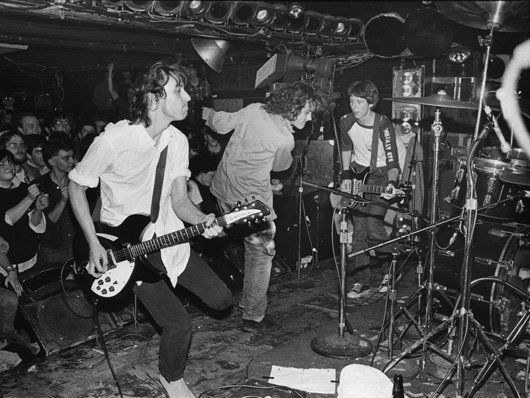
7. They have to do a great live show, and they have to tour a lot.  Case in point: This was 1982. This was from 2009.

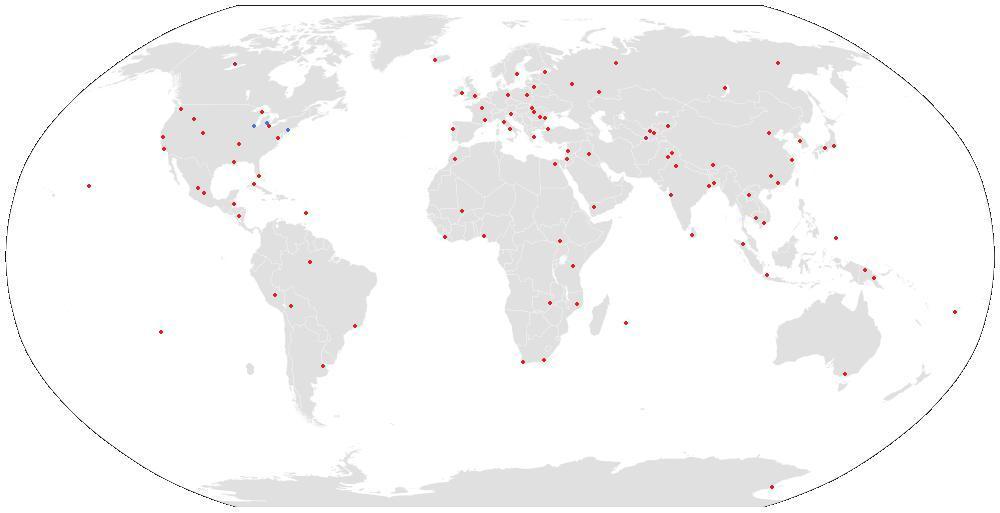
8. They don’t have to be from the South, but it’s good if they aren’t from New York or L.A.

9. They need to be sonically irresistable. Those early albums were always described as “jangly,” which I think means sharp and crisp and pure but unpretentious and catchy; a trait that mixes wonderfully with deliberately cloudy lyrics.  The mature albums were filled with the richness of organ and mandolin-rich folk-inflected melodies, and the latter day albums had a more bizarro and experimental sound.  But in all three phases they were consistently surprising and fun to listen to.  I will totally require that control of mood and startling versatility.

10. It helps if you get the impression that they live the lives of grizzled noirish detectives.

So there you have it.  If you can point me in the direction of a long-lived, wise, witty, politically poised, danceable, workable, kinetic-in-action, not-from-NYC-or-LA, sonically evocative-versatile band that somehow suggests grizzled noirish detectives — if you can just do that for me — then I will smile once again.

Share

Flint’s East Village in Pictures (1 of 3)

Posted by connor on October 26, 2011

For this blog’s relaunch, I wanted to kick off with something fun and colorful. It’s been a great week to explore my neighborhood, as many of the trees — tall maples and oaks — are hitting peak color about now.

I remember a few years ago I was participating in a reading series on Avenue A in Manhattan, and when my bio mentioned that I had grown up “in the East Village of Flint, Michigan” the audience chuckled, as if they were in on an inside joke. If there had been a joke, it would have been on them, since the neighborhood’s name and history are completely independent from the eponymous neighborhood in New York. “East Village” originated in 1976 with the elegiac supposition that Gary Custer’s East Village Magazine printed at 2nd Street and Avon Street, was “east of somewhere, specifically downtown, and following Marshal McLuhan’s ideas that advanced communications had created a ‘global village.’”

This has always been one of Flint’s more storied neighborhoods, and it is increasingly eclectic, economically, culturally, and artistically.  I hope that my Flint friends will see this and recognize the uniqueness of what is around them, and that my friends elsewhere will notice the startling beauty of the place I call home.


View Larger Map

The actual “name” of the East Village is debated. The area most closely associated with the magazine lies just west of the shuttered Central High School, and is identified by its neighborhood association as being “Central Park.” The area just south of here, in the elbow of I-69 and I-475 is appropriately known as the “Interchange Neighborhood” and includes the Fairfield Village apartments on Court Street and the Richert House public housing high-rise.  The larger residential core, which is both to the south and the east of Mott, is typically called the “College Cultural Neighborhood,”  particularly south of Court.  I do not prefer this term, as it feels contrived to me, and I think that the cosmopolitan connotations of “East Village” play to the neighborhood’s strengths in a more genuine way. But however contentious the terms may be, many residents of these areas identify themselves as “East Villagers,” and there there is general understanding of boundaries as being I-475, I-69, Dort Highway, and Robert T. Longway.


The area is one of the most affluent in the city, which grand stone mansions lining Woodlawn Park Drive. Historically the area has been more urbane and associated with government, education, and civil service than the city’s other affluent pocket of Woodcroft, on the West Side. Woodcroft retains a more corporate, suburban feel today.

Of course, East Village’s affluence has diminished over the years, suffering from the subprime mortgage crisis in addition to the host of other problems plaguing Flint. Many longtime residents have died or moved out as Flint has declined, and the neighborhood has experienced a demographic sea-change. It is now younger, poorer, and more racially diverse than it has been in the past. Although this is a source of anxiety to some, I think that in the long-term it makes the neighborhood more cosmopolitan, and more representative of Flint as a whole, and will allow it to play a more central role in the rejuvenation of the city.

In general, the southern parts of the neighborhood remain the most affluent, especially south of Court between Beard Street and Woodlawn Park.  East of Franklin and west of Gilkey Creek, the area is still solidly middle class. In this first installment, I focus on the area south of court and east of Maxine.

An ivy house.

A front yard graveyard; I’m hoping to do a separate album of the neighborhood’s Halloween displays, some of which are memorable.

Pierce Elementary. I took this picture from a distance, because there was an unending recess going on and I didn’t want to be “the guy with the big coat on the sidwalk taking pictures.”  Despite their impressive legacy, all of the Flint Community Schools are struggling today, with a 60+% drop in enrollment in the last fifteen years. While Pierce shares in these difficulties, it has a unique program involving a secondary campus in the Flint Cultural Center, where students regularly participate at the library, museums, planetarium, and other institutions.

Gilkey Creek is one of the defining features south of Court.  The creek is bridged for motor traffic at three points, and there are three more footbridges.  This bridge, near the school, leads to a pleasantly derelict network of footpaths through the wooded parts of Pierce Park.

Gilkey Creek at W. Vernon, looking west.

Pierce Park and Golf Course is one of the largest in the city, being approximately the same size as McKinley Park in Chicago or Fort Tryon Park in New York.  Until a few years ago, most of this park was given over to golf. As a kid I remember it being one of the less interesting and accessible parts of the neighborhood. But now that the city has stopped maintaining the park due to budgetary constraints, it has started to go feral again, reverting to the rolling prairie that probably occupied this site 150 years ago.

Walking the perimeter of the park takes over a half hour. In October you’ll see maples and oaks, honeysuckle and cattails, and tall grass.  You’ll hear crickets, see butterflies, and the lonely wind is uninterrupted because the park is typically uncrowded. In the distance, across Dort, you can see the remnants of derelict shops and pawn brokers crumbling like primitive mountains.  It’s beautiful and peaceful, in a post-apocalyptic sort of way.

The Grand Trunk Railroad and I-69 overpass is one border to the old South Side neighborhoods of Kent Park and Floral Park, which have a tragic history. These neighborhoods had been settled by middle class African Americans since the turn of the century, and became a hot spot for the development of Midwestern Blues music, along similar lines as in Detroit and Chicago. During the Civil Rights era, Flint became the first major city to legislate against racist housing compacts, which plagued the East Village (then known as Woodside) in particular.  The installation of I-69 decimated the Kent and Floral Parks, and effectively sealed off the black neighborhoods from the white. Of five Blues club in Kent and Floral Parks, only one, the Golden Leaf Club on Harrison, remains.

Although most of Pierce Park is derelict today, this community center remains open, I believe as a senior center.

A few years ago, this was a tennis court.  I put up some pictures of the court mid-decay when I visited for the closing of Central High School in 2009. Evidently the city decided to tear down the remnants after scavengers came and stripped the chain-link fence for scrap.

The western third of Pierce Park is covered in thick forest. From the road it appears to be impenetrable, but from the footbridge over Gilkey Creek, you can access a network of paths.

West of Pierce Park, the East Village becomes residential again, although this area was coterminous with the South Side neighborhood of Kent Park before I-69 went in.  Here a neat and well-landscaped drainage ditch runs toward its juncture with Gilkey Creek.

It’s easy to get lost in the little area south of Court, partly because the area is not closely gridded, but just as much due to mapping eccentricities. The two Brookside Drives, straddling Gilkey Creek, are not distinguished from each other by sign or map.  Here, the creek runs to the right, while on the left there are sprawling ranch-style houses on huge, wooded lots.

The second of the thee footbridges over Gilkey Creek is at Kensington.

A draintage ditch empties into Gilkey Creek.

Small rapids under the footbridge.

Linwood used to be an affluent street in the East Village. As in Detroit, a large part of the key to the city’s resurgence may lie in its recent and relative cheapness. In a time when many across the country are unable to afford their mortgage payments (including a lot of people in Flint), these mansions are owned by teachers, nurses, and other middle-class professionals. When the city does rebound, the East Village will be one of the quickest neighborhoods to recover, and those who have taken a risk on purchases here will be richly rewarded.

The East Village is architecturally eclectic. The houses on Linwood and Blanchard street are typically traditional designs: Georgians, Cape Cods, or perhaps Neo-Gothic in design. But there are several striking examples of Prairie-style houses.

In my novel, a few of my characters lived in one of the big old houses on Linwood. They lived lives of Midwestern decadence, although that is atypical of this neighborhood these days.

The next installment (coming soon!) will take in Mott Community College and the part of the East Village north of Court.

UPDATE: The second installment has been posted here.

Share
Categories: Flint,Personal

A panacea to your want of early morning rambling.

Posted by connor on October 24, 2011

Nothing but a picture of a lovely sunrise. Photo by André Karwath.

The short story here is simply that “the old blog is back.”

I started this blog in early 2004 (and if you want, you can still read the earliest, untitled entries here) and it was an eclectic thing.  I wrote about reading and writing and the arts.  I wrote about politics and religion and philosophy.  Most of all I wrote about my own life and the strange things I saw around me every day.  The comments were great, too. I can’t say that the blog ever became “popular,” but I did have a fairly steady following of twenty or so people — mostly family and friends — and occasionally I managed to excite a minor controversy that would lead to a spike in traffic.  I liked this blog, and I kept it this way for about four years.

The first shakeup happened in 2008, when my wife and I moved to Chicago, she started nursing school, and I was working a series of jobs to support us.  The blog was largely fallow until 2010, though I did update here and there.  I had started working as a web marketing consultant, and bought into the conventional wisdom that blogs should be focused, tight, almost nichelike in subject and content.  This makes sense for branding a business.  But I’m a writer and artist, and if you’re familiar with any of my work, then you know that it is highly syncretic and integrative.  My first attempt at rebranding the blog, as an academic discussion of the Gothic in a modern context, badly flopped (although it did yield the web’s most compelling analysis of swooning in the work of Ann Radcliffe). It was too niche. After nursing that project along for a year, I took a second stab, rebranding the blog as an exploration of self-publishing, based on my experiences with my novel Hungry Rats.  This was an even bigger flop, partly because there were already so many mature voices writing on this subject, but also because the subject didn’t hold my interest; it was too niche for me personally.  For most of 2011, I haven’t updated my blog at all, except to promote speaking events and readings.  A kind of a sad end to an eight-year project that had always been a lot of fun.

Well, I’m returning to blogging, but I’ve decided to go back to the old, spontaneous, wide-ranging discussions of its infancy.  Maybe I won’t attract many readers or promote my writing this way, but at the very least it will be an enjoyable way to share information with family and friends.  Contrary to popular belief, the advent of social media isn’t the death of blogging, although it enjoys less prominence now than before.  If you want to read more specifically about Writing, Art, Politics, Religion, the Gothic, or Self-Publishing, you can still do that; just use the category dropdown menu at right to find the posts you are looking for.  If you subscribe via RSS, or just check in from time to time, you’re going to find a hodgepodge of things from literary criticism to phenology.  It will be a panacea to your want of early morning rambling.  It will be, at the very least, an unselfconscious and reckless indulgence in words like “panacea.”

Share
Categories: blogging,Personal