Reflections on Benjamin Franklin, 2012: Franklin, the Romantic?

Posted by connor on January 18, 2012

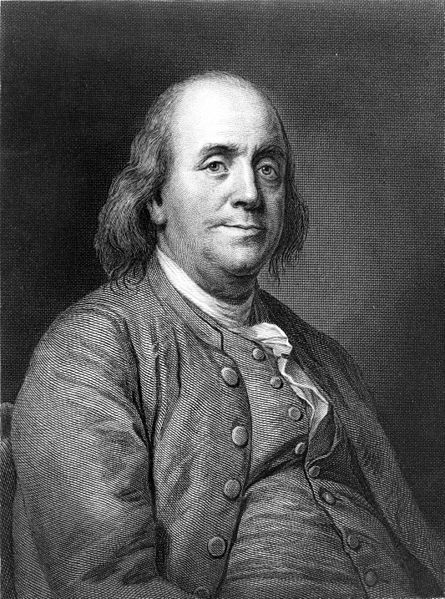
Benjamin Franklin’s 306th birthday was yesterday, January 17th.

I’m not an expert on the subject, but, as Walter Isaacson’s essay “What Would Ben Do?” notes, “[Franklin] has been vilified in romantic periods.” The question is how do we separate the spirit and content of romanticism from the momentary tropes of the/any “romantic period.” It its roots, perhaps there is something to this vilification: Franklin was a famed Enlightenment thinker, he tended toward the secular side of the religious spectrum, and he favored egalitarianism and social mobility. The romanticism of the late 1700s and early 1800s, by contrast, typically expressed a sensual engagement to faith, the elevation of emotion, and the nostalgic adoration of antiquity and nature. This oversimplifies, but these are clear points of tension.

Any -ism changes over time, and a lot of that pious yearning and neo-medieval ideations have been easily replaced by everything from Masonic symbolism to trance music. What has remained essential to romantic descendants around the world is the ascendancy of emotion; the idea that the ultimate truths — the most valid and permanent truths — are not those which can be attained by “reason” but which are derived from intuition and feeling. If you consider this superficially, as opposed to Franklin’s empirical and pragmatic approach to science, politics, even daily habits, then yes, there is indeed an opposition.

The problem with such a verdict, even from a historical point-of-view (that doesn’t consider the evolution of romantic tropes) is that it presumes the binary opposition of romanticism to empiricism, of the Romantics to the Enlightenment. Things are seldom that cut-and-dried. Many members of the Enlightenment later embraced romantic concepts, and it was a largely Enlightenment vocabulary that allowed thinkers, writers, and theorists like Immanuel Kant, Victor Hugo, and Jean-Jacques Rousseau to explore key romantic dilemmas. At its most direct and essential, the relationship could be summarized as follows: the human mind and its powers of reason are our most valuable tool to develop an understanding of the universe, but such an approach almost inevitably reveals the insufficiency of the human mind to understand everything. Self-styled “romantics” then took the further step of allowing emotion and intuition to occupy this mysterious, enigmatic place that is impervious to reason. Romanticism might be seen not as a refutation of reason, but as ancillary to it.

Which brings me back to Benjamin Franklin. Allowing that we believe in the contemporary relevance of both romanticism and of Franklin, there is just as much room for their cohabitation today as there was in the 18th century. If a utilitarian, pragmatic outlook — if useful day-to-day strategies — enables us to accomplish the most and the best of what our abilities allow, then we are not diminishing our presence in the world, but enhancing it. If such an approach is opposed to intuition, to the appreciation of the sublime, etc. etc., then yes, it is “unromantic.” But Franklin doesn’t strike one as being emotionally sterile or spiritually uninformed. He clearly embraced the validity of a wide variety of viewpoints, in philosophy, religion, and so forth… doing so is consummately “pragmatic.” If a pragmatic orientation to the world embraces romantic concepts — if it is a strategic orientation to actual problems as opposed to the dogmatic refutation of ideals — then it can be actively romantic. More, if such an orientation allows the accomplishment of great deeds — deeds which require the activation of emotional and intuitive resources — say, participation in the establishment of a new form of government — then it is actively romantic.

Share

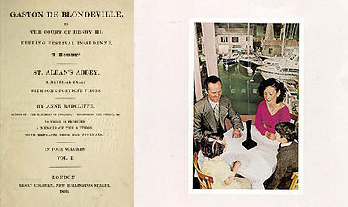
The Italian, by Ann Radcliffe.

Posted by connor on December 6, 2010

This past week I finished The Italian by Ann Radcliffe, meaning that I’ve finally read the Big Three of her novels, the other two being The Mysteries of Udolpho and The Romance of the Forest.

At some point, I’d like to talk about these three in comparison, as well as the consider The Italian alongside more contemporary writing, but I thought it would make sense to start out with a brief review.

Read the rest of this entry »

Share

Ann Radcliffe’s Italian

Posted by connor on August 9, 2010

Last week, in our discussion of Gothic Heroines and Natural Selection, Flawed Events posted about Jane Austen’s Northanger Abbey as referring to Ann Radcliffe. Austen pokes fun at Radcliffe, and at Gothic fiction in general, throughout Northanger Abbey. It’s a great book, funny and piquant, but I thought it might be nice to include for once passage of Radcliffe’s that shows what a powerful writer she really could be, and why she influenced writers from Keats to Hugo.

Read the rest of this entry »

Share

Gothic Heroines and Natural Selection Part II: Of Corset, Happens!

Posted by connor on July 29, 2010

On Tuesday, when I posted an entry on the propensity of Ann Radcliffe heroines to faint at the most inopportune moments, I got about 15 replies. Of course, only one of them was on this blog: the rest were scattered about Facebook and Twitter (which is what comes of social media cross-promotion, I suppose!), but it was a very intelligent conversation, so I’d like to write a follow-up, including some of the comments and responding to them.

But first, a hilarious example from Udolpho:

Read the rest of this entry »

Share

Gothic Heroines and Natural Selection

Posted by connor on July 27, 2010

A voice called her, but she was gone beyond its reach, for she had sunk senseless upon the ground: it was long before she revived, when she did, she found herself in the arms of a stranger, and made an effort to disengage herself. — Ann Radcliffe, The Romance of the Forest

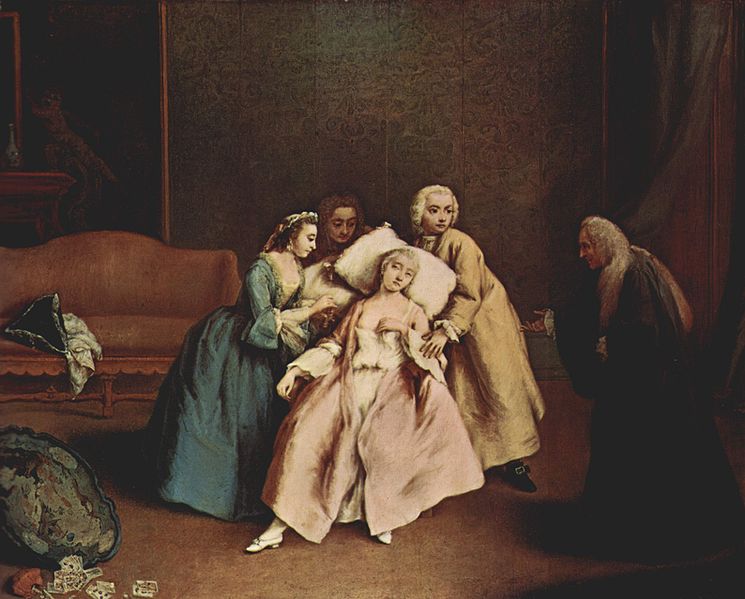
My wife and I are in the middle of Radcliffe’s The Italian, and just like you can never have a Michael Bay film without lots of explosions, there is no Ann Radcliffe without swooning. I’ve described Udolpho to people as “a great book with a lot of swooning and crying,” and any time I’ve encountered an argument that the book is anti-feminist, it usually centers around constant fainting (in response to shock, horror, or an insensitive comment) as the ultimate depiction of female passivity.

Personally, I think it’s problematic to call Radcliffe’s novels either feminist or anti-feminist… by the standards of her day, the heroines are admirably principled, logical, and empathetic. They have a social and ethical common-sense beyond that of their paramours. Radcliffe’s depiction of gender roles, however, is thoroughly traditional, and the significance of “proper conduct” trumps what most of us would consider more material concerns, like happiness and survival.

Regardless, it is problematic from a Darwinian perspective to have her heroines faint at the drop of a hat. Here someone is compromised and vulnerable — imprisoned, cut off from news and information, harassed by threats and speculation — and she eliminates the little control she maintains by being insensible, dead almost, and literally unable to learn, act, or express herself.

It certainly implies something of the submission-is-power theme, in that the same heroines never waver in their moral resolve, and always triumph in the end. And yet there is nothing intentional about their behavior… they aren’t deciding to swoon.

So I’m not really sure what to make of this occurrence. Is the conspicuous swooning significant to a larger understanding of the Gothic, or is it reflective of a historic attitude that is as impractical as it is sexist? I suspect the answer is both, but I don’t know that I can get more specific than that.

Share